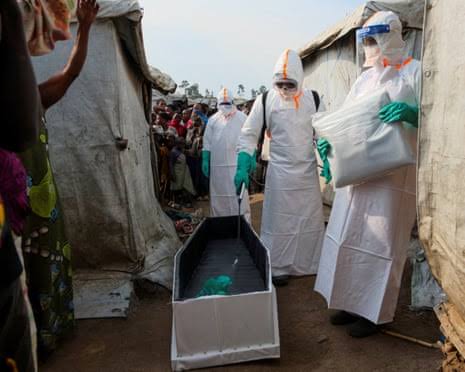
(Health officials. Photo Credit: The Guardian)
A rapidly worsening Ebola outbreak in the Democratic Republic of Congo has claimed more than 300 lives in just over a month, raising fears of a wider public health emergency as authorities battle conflict, limited medical resources, and growing community mistrust.
Health officials warn that the deadly virus continues to spread at an alarming pace, with hundreds of new infections overwhelming already fragile healthcare facilities in some of the country’s most volatile regions.
The crisis has become even more challenging as insecurity, population displacement, and shortages of critical medical supplies continue to hamper efforts to contain the outbreak, prompting fears that the epidemic could persist for many months.
Although neighboring Uganda has reported a small number of imported cases and has moved quickly to contain them, experts say the situation inside eastern DR Congo remains highly concerning and requires sustained international support.
According to the Democratic Republic of Congo’s National Public Health Institute (INSP), 1,115 confirmed Ebola cases and 304 deaths have been recorded since the outbreak was officially detected on May 15, representing a fatality rate of 26.3 percent.
The current outbreak is caused by the Bundibugyo strain of the Ebola virus, for which there are currently no licensed vaccines or approved treatments, making containment efforts significantly more difficult.
The worst-hit areas are Ituri, North Kivu, and South Kivu provinces, where decades of armed conflict, repeated displacement of communities, and weak healthcare systems have complicated emergency response efforts. Ituri’s capital, Bunia, accounts for more than 91 percent of reported infections and over 82 percent of recorded deaths.
Health authorities also reported that at least 78 healthcare workers have contracted the disease, with 18 deaths among medical personnel. Hospitals and treatment centres are struggling with shortages of chlorine, personal protective equipment, and other essential supplies, while some communities remain reluctant to cooperate with health workers because of mistrust and traditional burial practices.
The outbreak has also spread to neighboring Uganda, where 20 confirmed cases, including two deaths, have been reported. Meanwhile, a Congolese doctor working for the humanitarian organization ALIMA was recently diagnosed in France after travelling from DR Congo. The World Health Organization has stated that the risk of wider international spread remains low and has not recommended travel restrictions, although surveillance efforts continue to be strengthened.
Leave a Reply